Finding a sectional sofa near you that fits both your space and your lifestyle shouldn’t feel like a treasure hunt. Whether you’re settling into a first home, upgrading a living room, or hunting for a comfy sectional sofa that actually matches your décor, the process works best when you know what you’re looking for before you start looking. This guide walks you through the essentials: understanding what makes a sectional work, where to find quality options locally, and how to evaluate comfort and build quality in person. By the time you finish reading, you’ll have a clear roadmap to walk into a showroom or local retailer with confidence.
Table of Contents
ToggleKey Takeaways
- A sectional sofa near you offers superior flexibility and value—adapting to awkward room layouts and providing more seating per square foot than traditional sofas and chairs combined.
- Always measure your space precisely and test the furniture’s pathway to your room before purchasing, as sectionals that can’t physically fit through doors or hallways are expensive returns.
- Sectionals with high-density foam (2.0–2.5 lb per cubic foot), performance fabrics, and hardwood legs deliver better durability and resistance to stains and sagging than budget alternatives.
- Visit both furniture showrooms and independent local retailers to compare options and take advantage of personalized service, custom upholstery, and potential discounts on floor samples.
- Spend real time sitting, lying back, and inspecting seams and corners in person—cheap sectional sofas often reveal poor quality through loose stitching, fabric puckering, and rough construction.
- Always clarify warranty coverage, fabric protection plans, and return policies before buying, as these protections are where most post-purchase regrets arise.
Understanding Sectional Sofas: Why They’re Perfect For Modern Homes
A sectional sofa is a seating arrangement made up of individual pieces, typically a chaise, corner unit, or armless sections, that connect to form an L-shape, U-shape, or other configuration. Unlike a traditional sofa, a sectional adapts to awkward room layouts and gives you more seating flexibility without eating up floor space like two separate sofas would.
For modern homeowners, sectionals solve real problems. They fit snugly into corners, work in open-concept living areas, and let you reconfigure them as your needs change. A comfy sectional sofa in a small apartment might be an L-shaped unit that slides against two walls: in a larger family room, you might go U-shaped with a chaise on both ends. The modular nature means you’re buying what you actually need, no wasted furniture doing nothing.
Sectionals also tend to offer better value per seat than buying a sofa plus chairs. If you’re sitting three people on a sectional versus a sofa-and-chair combo, you’re using your money and floor space more efficiently. That practical advantage is why sectionals have become a staple in modern home design, from first-time buyers working with tight budgets to established homeowners who appreciate flexibility.
Where To Shop For Sectional Sofas Locally
Furniture Showrooms & Department Stores
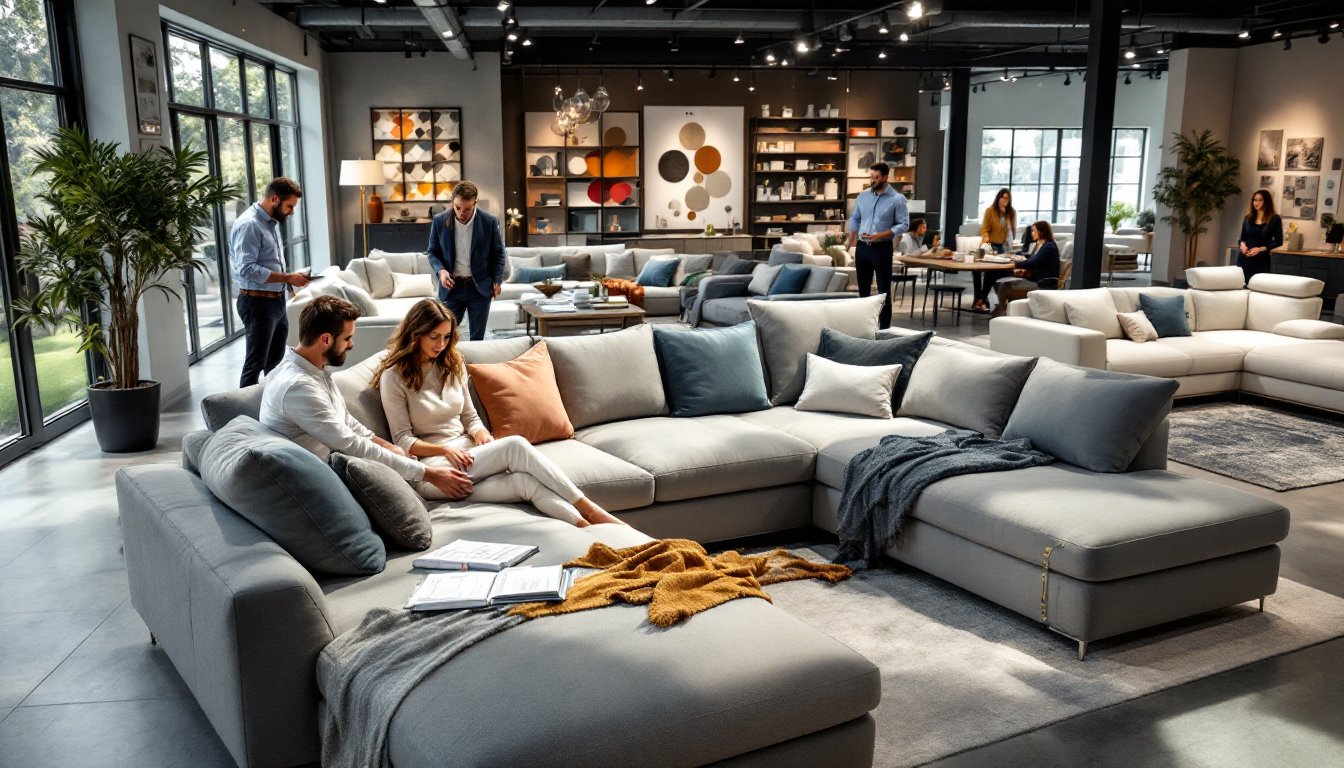
Furniture showrooms and larger department stores remain the most reliable places to find a sectional sofa nearby. National chains like Wayfair, Ashley Furniture HomeStore, and regional equivalents maintain physical locations where you can see and touch actual floor samples. The advantage is immediate: you can test firmness, check the fabric texture, see how colors look in your own phone’s photo, and ask staff about delivery, assembly, and warranty details on the spot.
When you visit, bring your phone with room measurements and photos of your space. Staff can walk you through how a particular sectional footprint, often expressed in inches for depth, width, and height, translates to your living room. They’ll also explain whether the piece arrives assembled or flat-packed, and what assembly costs you’re looking at. Department stores sometimes bundle delivery and assembly into their pricing, which can save you money and headaches.
Local Independent Furniture Retailers
Independent furniture retailers often get overlooked, but they’re worth hunting for. Local shops typically stock pieces you won’t find in big-box stores, offer more personalized service, and sometimes provide custom upholstery options or fabric choices. When you search for a “sectional sofa nearby,” don’t skip the smaller retailers, they may have limited hours or a less flashy website, but the quality and uniqueness often justify the effort.
Independent retailers also tend to have relationships with local delivery services and upholsterers, which means faster turnarounds and easier customization. If you find a fabric pattern you love but it’s not available on the in-stock sectional you want, many independent shops can special-order it or work with you on alternatives. Ask about floor samples and last-season inventory: you’ll often find discounted options if you’re flexible on color or style.
Measuring Your Space: The Essential First Step
Before you set foot in a showroom, measure your room like you’re framing a wall, precision matters. Use a metal measuring tape, not a cloth one, and measure from wall to wall. Write down the length and width of your living room, the height of your ceiling, and the distance from potential sofa placement to doorways, windows, and architectural features like fireplaces or TV walls.
Next, measure the actual pathways furniture will take to reach your room. Will a sectional need to navigate a staircase, go through double doors, or make a sharp turn down a hallway? Sketch a rough overhead view of your room and mark these constraints. This prevents the heartbreak of ordering a sectional that physically can’t get into your space.
When you’re at a retailer examining a specific sectional, ask for its footprint in inches: depth (from backrest to front edge), width (the full span when all pieces are connected), and diagonal depth if it’s an L-shaped configuration. Most retailers have spec sheets on hand. A sectional that’s 130 inches wide might be perfect for your room on paper but impractical if your doorway is only 36 inches wide. Measurements eliminate guesswork and prevent expensive returns or exchanges.
Key Factors To Consider Before You Buy
Fabric & Durability: Sectionals get heavy use, so fabric choice matters. Leather and performance fabrics (synthetic blends designed to resist stains) are easier to clean than natural linen or cotton. If you have kids or pets, performance upholstery is worth the investment, it resists spills, fading, and pilling far better than standard fabrics. Ask the retailer for sample swatches and take them home to see how they look under your actual lighting.
Configuration & Modularity: Not all sectionals are created equal. Some have fixed arms and backs: others have swappable pieces. If flexibility is your priority, look for models with modular components. This matters when you’re moving or redesigning, you can rearrange sections instead of being locked into one layout.
Cushion Firmness: Comfort is subjective, but “firmness” is measurable. Sectionals with high-density foam (typically 2.0 to 2.5 lb per cubic foot) will hold their shape longer than lower-density foam. Sit on the floor model for at least a minute, bounce gently, and see if it feels supportive. A sectional that’s too soft might sag in a year: one that’s too firm might feel like a park bench. Retailers can usually tell you the foam density if you ask.
Legs & Base: Check what’s holding the sectional up. Wooden legs are more durable than plastic: hardwood is better than plywood. Look under the sofa (yes, really) and check for visible joinery. If you notice staples or poor gluing, that’s a red flag. Sectionals with attached legs are harder to clean under than ones with lift-off legs or feet, so consider your household’s cleaning habits.
Evaluating Comfort & Quality In Person
When you’re standing in front of a sectional sofa nearby, don’t just sit for three seconds and walk away. Spend real time on it. Lie back, test the arms for comfortable leaning, and see if your head is properly supported by the backrest. Bring a family member and sit together to test how the sectional feels with actual weight distribution.
Run your hands along the seams, check for loose stitching or fabric puckering, and inspect the underside. Look at corners and crevices, these areas are where quality (or lack of it) shows up first. Cheap sectionals often have rough seams, uneven fabric alignment at corners, or visible glue marks. The fabric should be taut without looking strained.
Besides hands-on testing, interior design inspiration can help you visualize a sectional in your home. Resources like Houzz’s sectional sofa collection and Homedit design guides showcase real homes with sectionals in different styles and room layouts, giving you a sense of how various pieces function in actual spaces. Also, Apartment Therapy’s small space living ideas provide clever solutions if you’re working with a compact footprint.
Ask the retailer about warranty coverage, fabric protection plans, and return policies. A good sectional should come with at least a 1-year structural warranty. If they offer a fabric warranty, understand what it covers, some protect only against manufacturing defects, not everyday wear. Don’t skip this conversation: it’s where most regrets happen after purchase.